
The gap, plainly.

A student is usually not missing everything. They are missing one specific thing their year of the syllabus assumes they have. That gap is narrow enough to name and cheap enough to buy, which is why a student-run organisation can close it.

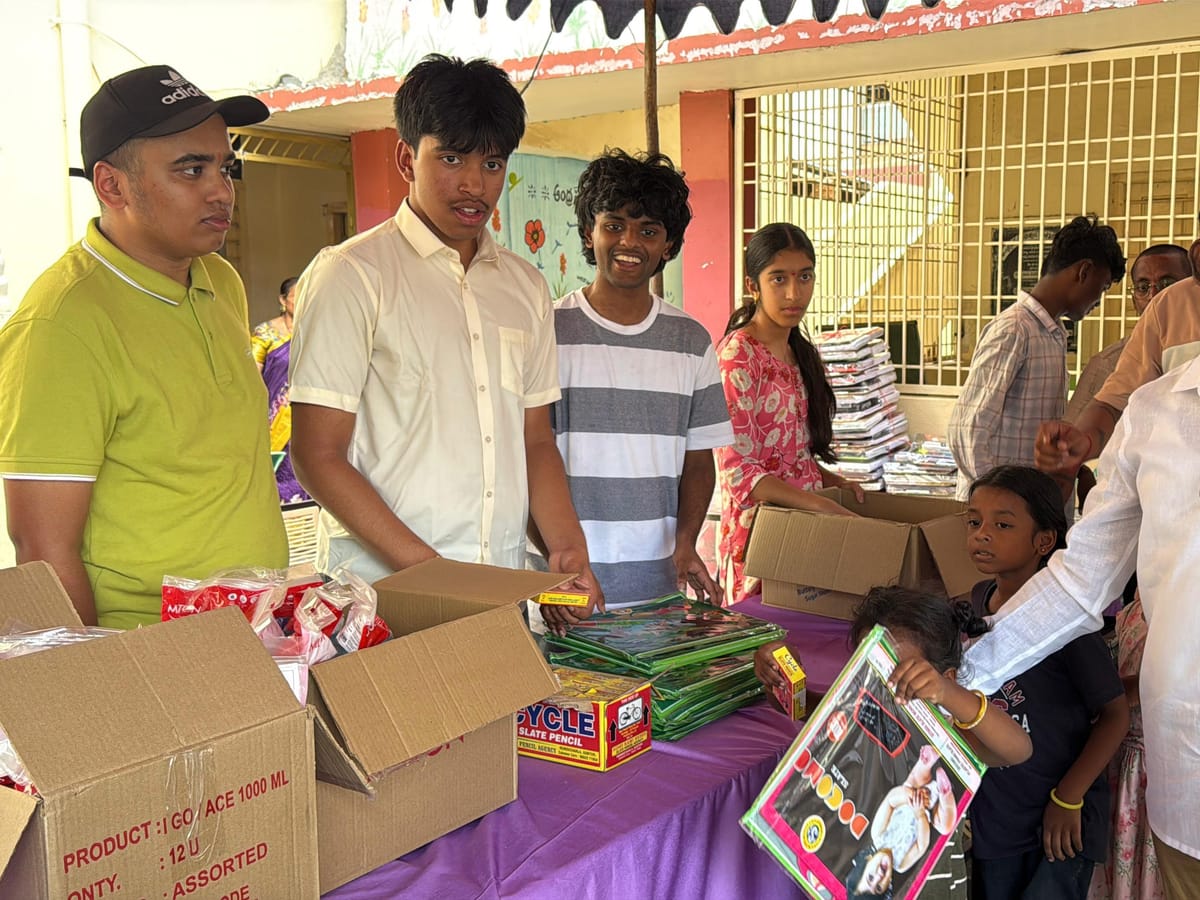
What that thing is depends on where the school is. In Andhra Pradesh, where the first campaign ran, the state scheme already supplies uniforms, shoes, a school bag, textbooks and generic notebooks. What it leaves out is a compass box, an atlas, a slate, and a notebook matched to a student's grade. Those became the kit.

What the gap looks like, and what the evidence says.

  • 15.7%

    of Std III children in rural Andhra Pradesh can read a Std II text

  • 37.7%

    of Std V children in rural Andhra Pradesh can read a Std II text

  • 10%

    of rural students in India received free or subsidised stationery, against 54% for textbooks (2017–18)

Most students are behind the year they are in

In rural Andhra Pradesh in 2024, fewer than one in six children in Std III could read a passage written for Std II. By Std V, still fewer than two in five could. About a third of Std V children could do a division sum.

A child who is a year or two behind needs material pitched at where they are and where their class is going: a notebook ruled for their grade, a geometry box when the syllabus reaches angles, an atlas when it reaches maps.
Stationery is the part families are left to buy

When the National Statistical Office last surveyed what households spend on schooling, in 2017–18, just over half of rural students received free or subsidised textbooks, but only one in ten received free or subsidised stationery. In rural Andhra Pradesh the figures were 49.6% and 8.5%. Books, stationery and uniform made up about a quarter of what rural households spent on each student.

Andhra Pradesh has since begun supplying textbooks, generic notebooks, a bag and a uniform through the state scheme, so these figures describe the years before it. What the scheme still leaves out is what Learning Kits supplies: compass boxes, atlases, slates, and notebooks matched to a grade.

Writing by hand is part of how children learn

In a study of five-year-olds who could not yet read, the brain network used for reading responded to letters only after the children had practised writing those letters by hand. Typing and tracing them did not produce the same response.

Materials only help when they fit the child and get used

When textbooks were given to schools in rural Kenya, average test scores did not rise. Only students who were already strong benefited, partly because the books were written above most pupils’ level.

A 2023 review by the World Bank, UNICEF and others lists extra inputs on their own as a poor use of money, and in the same breath says that good materials pitched at the right level, used alongside good teaching, can make a big difference. That is why every Learning Kit is matched to a grade, and why teachers decide what that grade needs.

One child, one teacher, one book, and one pen can change the world.

Malala Yousafzai United Nations Youth Assembly, 2013

Is the world so poor that it cannot give me a toy and a book, instead of forcing me to take a gun or a tool?

A child’s question, as told by Kailash Satyarthi Nobel Lecture, 2014

What the organisation values

  1. Dignity

    Every student is treated with respect, in person and in how we tell their story.

  2. Proximity

    We work where we have real ties, close to the schools we serve.

  3. Deference

    Teachers and local partners decide what each grade needs.

  4. Stewardship

    We buy supplies at local prices and keep every receipt.

  5. Honesty

    We say plainly what we have done and what is still to come.

Four high school volunteers standing behind a table of opened cartons, sorting slate pencils, folders and notebooks while students wait at the other side.

Who runs it

Vidora Foundation is run by high school students, organised into chapters that raise for the schools they serve.

The first chapter is in Frisco, Texas. The first campaign ran in Palnadu and Prakasam districts, Andhra Pradesh, India.

Meet the team